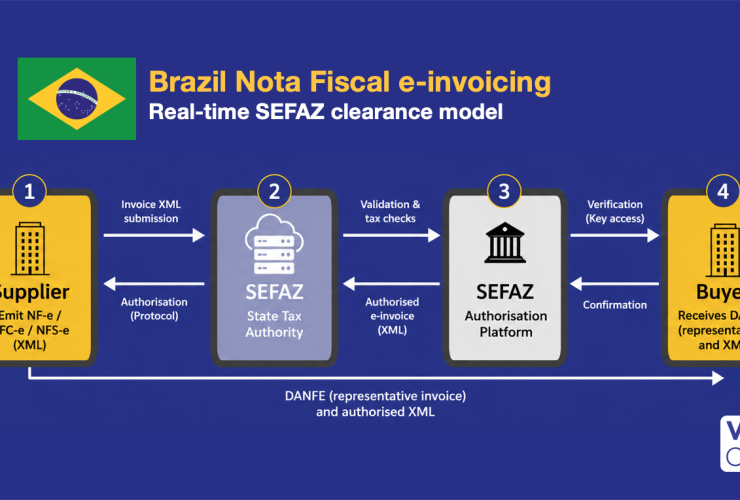
CBS regime brings foreign providers into tax net; major changes in place since 1 August 2026
Under the 30 April 2026 gazetted Decree No 12,955/2026, high-level details of the new federal CBS (Contribuição sobre Bens e Serviço) tax on digital services. Further legislation on the second new tax, state-level IBS, is coming soon.
Most of the requirements started 1 August 2026, including tax registrations, e-invoicing and bookkeeping obligations.
Digital services subject to Brazilian CBS
The Decree identifies the following supplies as liable to CBS and the state IBS tax:
- Streaming and download digital content
- SaaS / cloud based software
- Platform intermediation services
- Online advertising
- Other internet-base services
Shift to place of supply triggers VAT for non-residents
This is part of the 2026-33 implementation of VAT in Brazil. The introduction of the federal CBS and state IBS introduce (which are based on global VAT regimes) replace four existing and cascading taxes. For non-residents, a further change is that CBS and IBS are payable where the service is consumed – destination versus current origin as the place of supply.
Registration required with no threshold
This means non-residents will have to register for the new taxes – applying to Receita Federal (Federal Revenue) for a CNPJ (Cadastro Nacional da Pessoa Jurídica) taxpayer number.
There is no registration threshold. Appointment of a local tax or fiscal representative is optional.
Registration is since 1 August 2026.
Brazil e-invoicing and record-keeping obligations
Non-resident digital service providers may be required to comply with Brazil’s electronic invoicing and bookkeeping obligations from 1 August 2026, including:
- Issuing Brazil NFS-e or equivalent electronic service invoices for digital or remote services supplied into Brazil, including details of the Brazilian taxable portion, invoiced amounts, and references to foreign invoices or foreign exchange documentation where relevant.
- Retaining supporting tax and commercial records, including contracts, invoices, customs filings, payment confirmations, and FX documentation, for the statutory retention period and making them available to the Brazilian tax authorities on request.
- Ensuring all invoicing and declaration data is accurate, complete, and consistent across filings and supporting documentation, as discrepancies or omissions may trigger tax assessments, interest, penalties, or extended liability exposure.
B2B local customer self-account
As with the recommended OECD best practices, the new obligations should only fall on B2C transactions. Business customers of non-residents or intermediaries should be able to self-account for CBS.
Phased rates
The consolidated rate will be approximately 26.5%, with a blend of the CBS (8.8%) and IBS (17.7%) indirect taxes.
The two new main indirect taxes replace four existing state and federal taxes starting from 2026 and completing by 2033:
- CBS 8.8% (Contribuição sobre Bens e Serviços – Contribution on Goods and Services) federal tax on consumption – replacing PIS and Cofins
- IBS 17.7% (Imposto sobre Bens e Serviços – Tax on Goods and Services) state and municipal taxes – replacing ICMS and ISS.
Digital platforms and marketplace liabilities
The new proposals also make facilitating marketplaces or similar digital platforms liable for CBS and IBS collections. This is triggered where the platform is responsible for any of the following elements: setting T&C’s; payments; delivery. Platforms facilitating just listings or payments are excluded from this.
Central and South America VAT on digital services
| Comments (click for details) | Rate | Date | Threshold | Comments |
| Argentina | 21% | Apr 2018 | – | |
| Aruba | 4% | Jan 2023 | - | |
| Bahamas | 10% | Jan 2015 | BSD 100,000 | |
| Barbados | 17.5% | Dec 2019 | BBD 200,000 | |
| Bolivia | 13% | Nov 2022 | - | |
| Brazil | 26.5% | 2026 | Nil | Aug 2026 first new VAT obligations |
| Chile | 19% | Jun 2020 | Nil | |
| Colombia | 19% | Jan-18 | Nil | |
| Costa Rica | 13% | Oct 2020 | Nil | Withholding VAT option |
| Curaçao | 6% | 2020 | Nil | |
| Dominican Republic | 18% | 2025 | Nil | Currently withholding VAT |
| Ecuador | 12% | 2025 | Nil | Previously withholding VAT |
| El Salvador | 13% | 2022 | - | Replace Withholding VAT |
| Grenada | 10% | 2027 | - | |
| Guatemala | 12% | TBC | - | |
| Honduras | 15% | 2022 | HNL 250,000 | |
| Panama | 10% | 2022 | - | Withholding VAT |
| Paraguay | 10% | Jan-21 | Nil | Withholding VAT; 4.5% DST |
| Peru | 18% | 2024 | Nil | Withholding VAT |
| Puerto Rico | 10.5% | Jan 2020 | $100,000; or 200 transactions | Marketplaces |
| Suriname | 10% | Jan 2023 | SRD 500,000 | |
| Uruguay | 22% | Jan 2018 | Nil | VAT and Withholding Tax |