Bulgaria domestic B2B e-invoicing and real-time digital reporting from January 2028 feeding pre-filled VAT returns.
Bulgaria’s Ministry of Finance published draft VAT legislation on 23 September 2026 introducing mandatory structured e-invoicing, real-time digital reporting with pre-filled VAT returns from1 January 2028.

Centralised National Revenue Agency (NRA) e-invoicing
This will be followed by July 2030 ViDA Digital Reporting Requirements for e-invoicing and e-reporting on intra-community supplies.
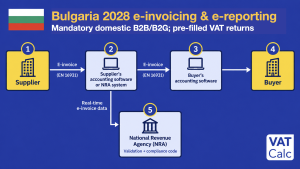
The proposals would create a national e-invoicing and digital reporting system operated by the NRA. Invoice data would be transmitted to the NRA in real time, while existing VAT sales and purchase ledgers would be abolished and replaced by pre-filled VAT returns.
The draft is open for consultation until 23 October 2026 and must subsequently be approved by the Council of Ministers and National Assembly.
Bulgaria e-invoicing and e-reporting timeline
- 23 September 2026 – draft VAT amendments published
- 23 October 2026 – public consultation closes
- By July 2027 – NRA testing environment expected
- 1 January 2028 – mandatory domestic e-invoicing and real-time digital reporting
- 1 July 2028 – new e-invoicing penalties apply
Who will be subject to mandatory e-invoicing?
VAT-registered suppliers established in Bulgaria would have to issue structured electronic invoices for domestic supplies and advance payments to Bulgarian-established taxable persons, non-taxable legal persons and public authorities.
Non-VAT-registered suppliers would also have to issue e-invoices when supplying public authorities.
Invoices must comply with the European EN 16931 standard.
The mandate would not apply to certain transactions, including intra-Community supplies, supplies by intermediaries in triangular transactions, supplies by VAT-registered persons not established in Bulgaria, and transactions documented at the time of sale using an extended fiscal-device receipt.
Real-time e-reporting to the NRA
E-invoicing and digital reporting would operate through a new national system administered by the NRA.
Businesses could issue invoices directly through the national platform or through their own invoicing software. Where their own systems are used, the invoice data would have to be transmitted to the NRA in real time.
An e-invoice would be considered issued and received once the national system has validated it and generated a unique compliance code. The recipient’s consent would not be required.
This means Bulgaria’s 2028 reform is considerably broader than an invoice-format mandate. E-invoicing and transaction reporting would effectively become a single continuous VAT compliance process.
Pre-filled VAT returns from e-invoice data
The same transaction data would then be used by the NRA for VAT return preparation. Read more about VATCalc’s pre-filled VAT return reconciliation functionality.
Existing VAT sales and purchase ledgers would be abolished. The NRA would instead provide taxpayers with a pre-filled VAT return by the second day of the month following each VAT period.
Businesses could supplement and correct the return before filing.
The proposed model therefore creates a direct data chain:
Structured e-invoice → real-time NRA reporting → validation → pre-filled VAT return
Input VAT deduction linked to valid e-invoices
The reform also introduces an important input VAT control.
Where a supplier is required to issue an electronic invoice, holding a valid e-invoice would become a substantive condition for the recipient to deduct input VAT.
Invoice validation and reconciliation will therefore become important not only for e-invoicing compliance but also for protecting VAT recovery.
Testing and penalties
The NRA must provide a testing environment at least six months before implementation, meaning businesses should have access by July 2027 if the January 2028 start date is retained.
Detailed technical requirements will be established separately by ordinance of the Minister of Finance.
From 1 July 2028, failure to issue a required e-invoice would attract a penalty based on the VAT not charged, subject to minimum penalties of €750 for individuals and €1,500 for legal entities.
The Ministry estimates the new system will cost approximately €20 million, while generating an additional €350 million in VAT revenue in 2028.
Bulgaria aligns domestic reporting with ViDA
The proposals implement elements of the EU’s VAT in the Digital Age (ViDA) reforms and use the new flexibility for Member States to introduce mandatory domestic structured e-invoicing.
Bulgaria’s domestic regime would start on 1 January 2028, ahead of ViDA’s harmonised intra-EU B2B digital reporting requirements from 1 July 2030.
This is an important distinction for businesses operating across Europe. Bulgaria’s 2028 domestic requirements and the later EU cross-border ViDA regime will not have identical scope or timelines, but both reflect the same shift towards structured transactional VAT data.
For businesses, the challenge is therefore wider than connecting to another e-invoicing network. VAT determination, invoice creation, real-time reporting, input VAT validation and VAT returns are increasingly becoming parts of the same digital compliance process.
Check VAT Calc’s global live VAT invoice transaction and e-invoice reporting tracker to see where else real-time submissions of invoices is being implemented. Our VAT Calculator tax engine can provide instant global VAT or GST calculations for your e-invoicing or real-time reporting obligations.