
Burkina Faso launches certified electronic invoicing system — mandatory 1st July 2026
-
Burkina Faso has formally launched a certified electronic invoicing platform (Facture électronique certifiée), replacing its legacy “normalised” invoicing regime and enabling real-time transmission of invoice data to the tax authority.
- B2B and B2C domestic VAT transactions are in-scope for the pre-clearance Continuous Transaction Control e-invoicing model. Non-resident VAT registered businesses are out of scope.
-
Use of the system will become mandatory for taxpayers from 1 July 2026, following a short transition period.
DGI progresses digital VAT
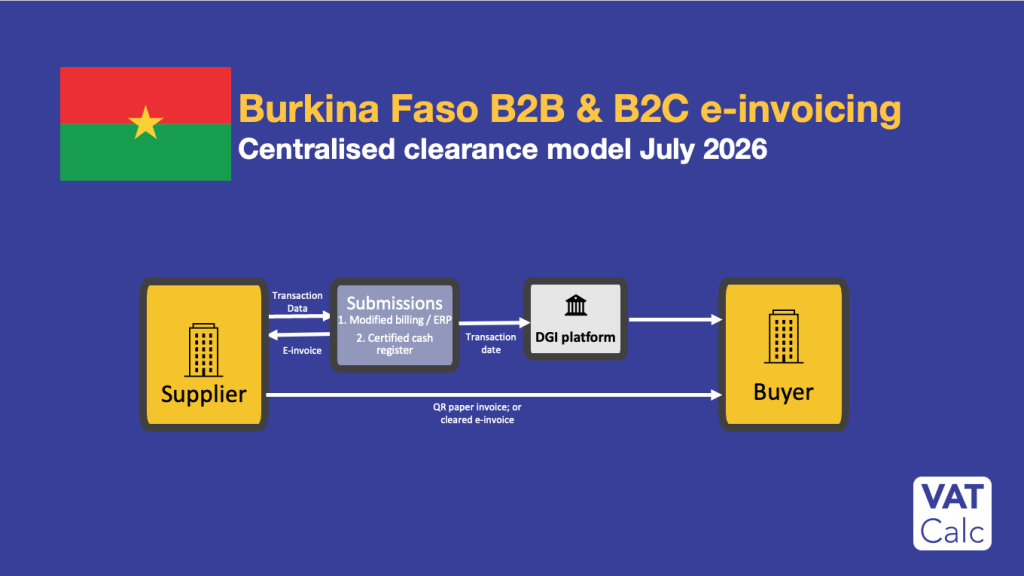
On 6 January 2026, Burkina Faso’s Directorate General of Taxes (DGI) officially launched a nationwide certified electronic invoicing system in Ouagadougou. The launch marks a structural upgrade from the country’s earlier normalised invoicing framework introduced in 2017 to a fully digital, centrally supervised platform.
After an initial transition phase during 2026, the tax authorities have confirmed that the system will become mandatory from 1 July 2026 for affected taxpayers – domesic residents with taxable supplies above XOF 50m per annum (approx €76,225).
How the certified e-invoicing system works
The new platform introduces several fundamental capabilities:
-
Real-time transmission of invoice data directly to the tax administration via Système Électronique Certifié de Facturation” (SECeF).
-
End-to-end traceability of commercial transactions, creating a verifiable audit trail.
- Draft sales invoices may be submitted by:
- DGI provided add-on to existing building systems for larger businesses; or
- Certified fiscal cash register.
- Customers will receive their invoice from the DGI platform which will include a QR Code for print-off.
-
Greater transparency in business operations, reducing manual intervention and informal practices.
-
Improved tax compliance and fraud prevention, particularly for VAT and indirect taxes.
Penalties regime
The General Tax Code has been updated to strengthen sanctions for non-compliance with the electronic invoicing requirements. The revised penalty framework is as follows:
-
Issuance of fraudulent or falsified electronic invoices:
The issuance of fraudulent or falsified electronic invoices is punishable by a fine of XOF 2,000,000 (approximately EUR 3,050) per invoice, without prejudice to any applicable criminal sanctions.
-
Failure to issue a certified electronic invoice:
Taxpayers are subject to a penalty equal to five times the amount of VAT at risk, with a minimum fine of XOF 500,000. In the case of repeated infringements, the penalty increases to ten times the amount of VAT at risk, subject to a minimum fine of XOF 1,000,000 (approximately EUR 1,520).
-
Non-compliance by electronic invoicing system providers:
Providers of electronic invoicing solutions, or taxpayers developing in-house systems, that do not comply with the certification requirements are liable to a fine of XOF 1,000,000 (approximately EUR 1,520). Repeat offences attract an increased fine of XOF 2,000,000 (approximately EUR 3,050).
Rather than relying primarily on periodic declarations and physical audits, the DGI will increasingly monitor taxpayer activity through continuous data flows captured at the point of invoicing. The model aligns with a broader global shift toward Continuous Transaction Controls (CTC) and real-time reporting architectures.
Burkina Faso is not alone in adopting certified e-invoicing models:
-
Rwanda introduced mandatory electronic invoicing for VAT-registered taxpayers in 2021, with direct transmission to the revenue authority.
-
Kenya rolled out its e-TIMS system between 2021 and 2022, requiring certified electronic receipts and continuous data reporting.
Both experiences demonstrate that compliance uptake improves significantly when taxpayer education, affordable hardware solutions and responsive technical support accompany the mandate.
Middle East & Africa e-invoicing