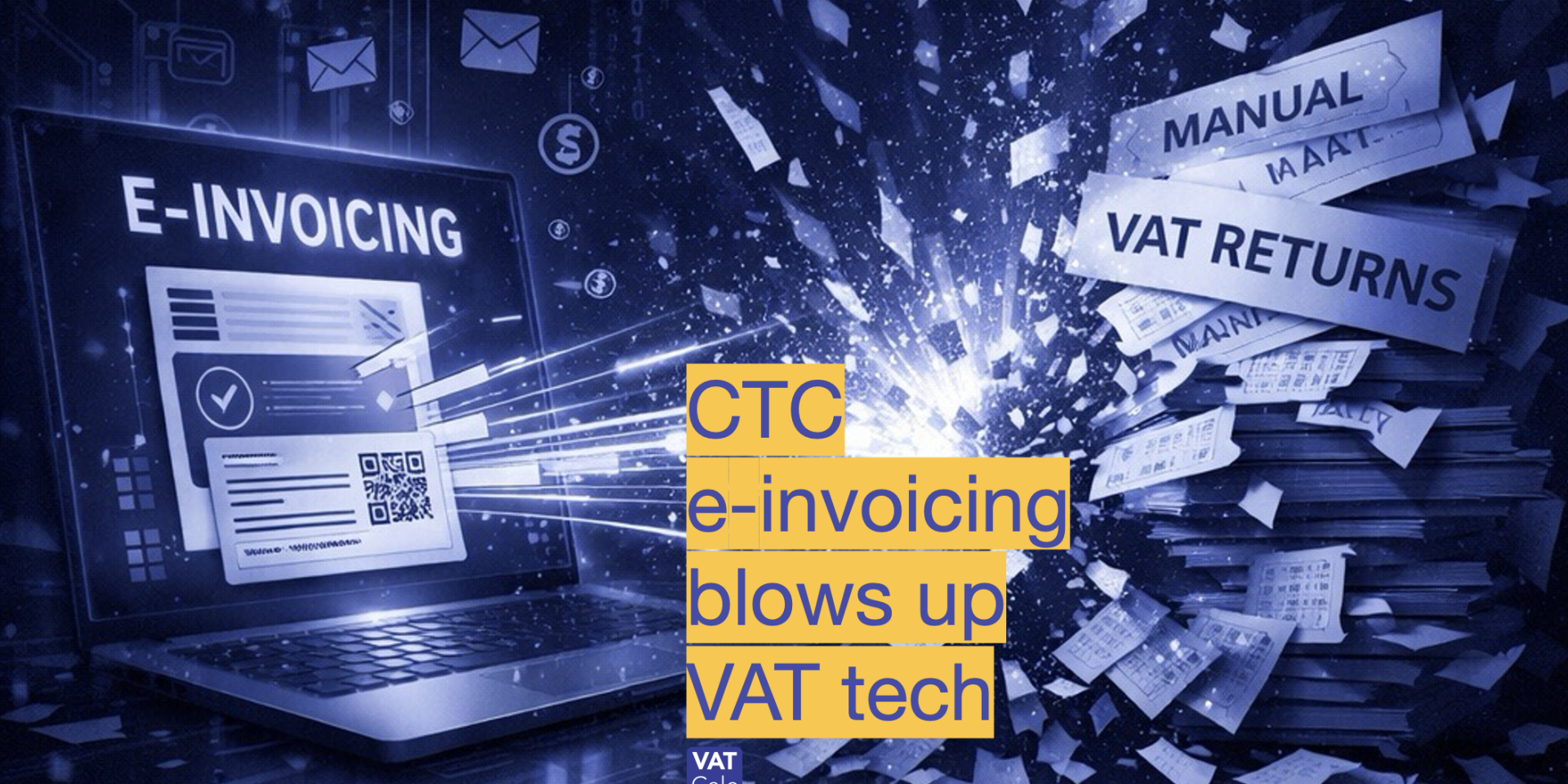
Continuous Transaction Controls on e-invoicing exposing cracks in ERP, tax engine and VAT processes
For years, businesses have been able to get away with a fragmented, often mostly manual VAT process.
The ERP calculates tax. A tax engine may sit alongside it. Accounts payable manually reviews invoices. VAT teams spend weeks reconciling data before filing returns.

It isn’t perfect, but it works because there is time to find and fix mistakes.
Continuous Transaction Controls breaks the traditional VAT review-and-file model
Tax authorities are no longer waiting for the VAT return. Continuous Transaction Controls (CTCs) fundamentally change the relationship between taxpayers and tax authorities. Through e-invoicing and real-time reporting mandates, governments increasingly see individual transactions as they happen, live, rather than waiting weeks or months for a VAT return
Under the EU’s VAT in the Digital Age, intra-community transactions must be e-reported within 10 days. Some domestic regimes are already moving faster – Spain e-reporting will be 4 days; Poland e-invoicing live to KSeF portal. Tax and Finance departments responsible for reporting e-invoicing or returns with that level of e-invoicing fragmentation has got a huge admin task coming.
And tax authorities now hold the strongest hand they have ever had.
They can compare supplier and customer data, identify mismatches automatically and challenge transactions long before a VAT return is submitted. Heck, they will just send you a pre-filled VAT return for you to check off.
Where the cracks start to appear in the digital VAT era
Many existing VAT technology stacks were never designed for this environment. The weaknesses are already becoming obvious:
- ERP tax functionality often lacks the sophistication needed for complex cross-border VAT decisions
- Legacy tax engines focus on determination but stop short of e-invoicing, e-reporting and VAT return obligations
- Accounts payable teams still rely heavily on manual invoice review
- E-invoicing data, e-reporting submissions and VAT returns are frequently managed in separate systems
- Every new country mandate introduces fresh mapping, integration and maintenance costs
What was once a manageable reconciliation exercise becomes a compliance risk visible directly to the tax authority.
The uncomfortable reality is that many businesses still treat VAT determination, e-invoicing, e-reporting and VAT returns as separate processes.
CTCs demand they become one.
Why VATCalc is unique in this CTC future – worlds only singe tax engine, e-invoicing and reporting application
VATCalc takes a different approach.
Instead of bolting together multiple technologies, VATCalc combines:
- VAT determination (our VAT Calculator tax engine)
- Legislative reasoning (our national tax-law codified audits)
- E-invoicing requirements
- E-reporting obligations, uniquely with over 30 countries covered
- VAT return preparationin our VAT Filer
within a single legislation-coded application.
The same transaction logic drives every stage of compliance.
As tax authorities expand reporting requirements, VATCalc updates centrally. No new tax engine implementation. No separate e-reporting project. No country-by-country rebuild.
And with VATCalc’s purpose-built agentic AI capabilities, businesses can interrogate VAT logic, reporting obligations and filing treatments directly against codified legislation.
CTCs are not another compliance obligation.
They are exposing whether your VAT technology stack was ever fit for purpose in the first place.