EU targets e-commerce & warehouse multiple VAT registrations with OSS single VAT return option
The European Commission has published the first detailed technical rules for the Transfer of Own Goods (TOOG) scheme, one of the flagship measures within the VAT in the Digital Age (ViDA) Single VAT Registration (SVR) reforms.
These reforms come into place from 1 July 2028. There are SVR 2027 initial reforms due 1 January 2027.

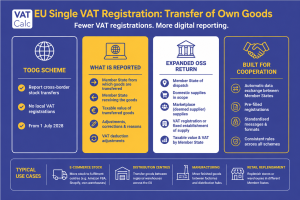
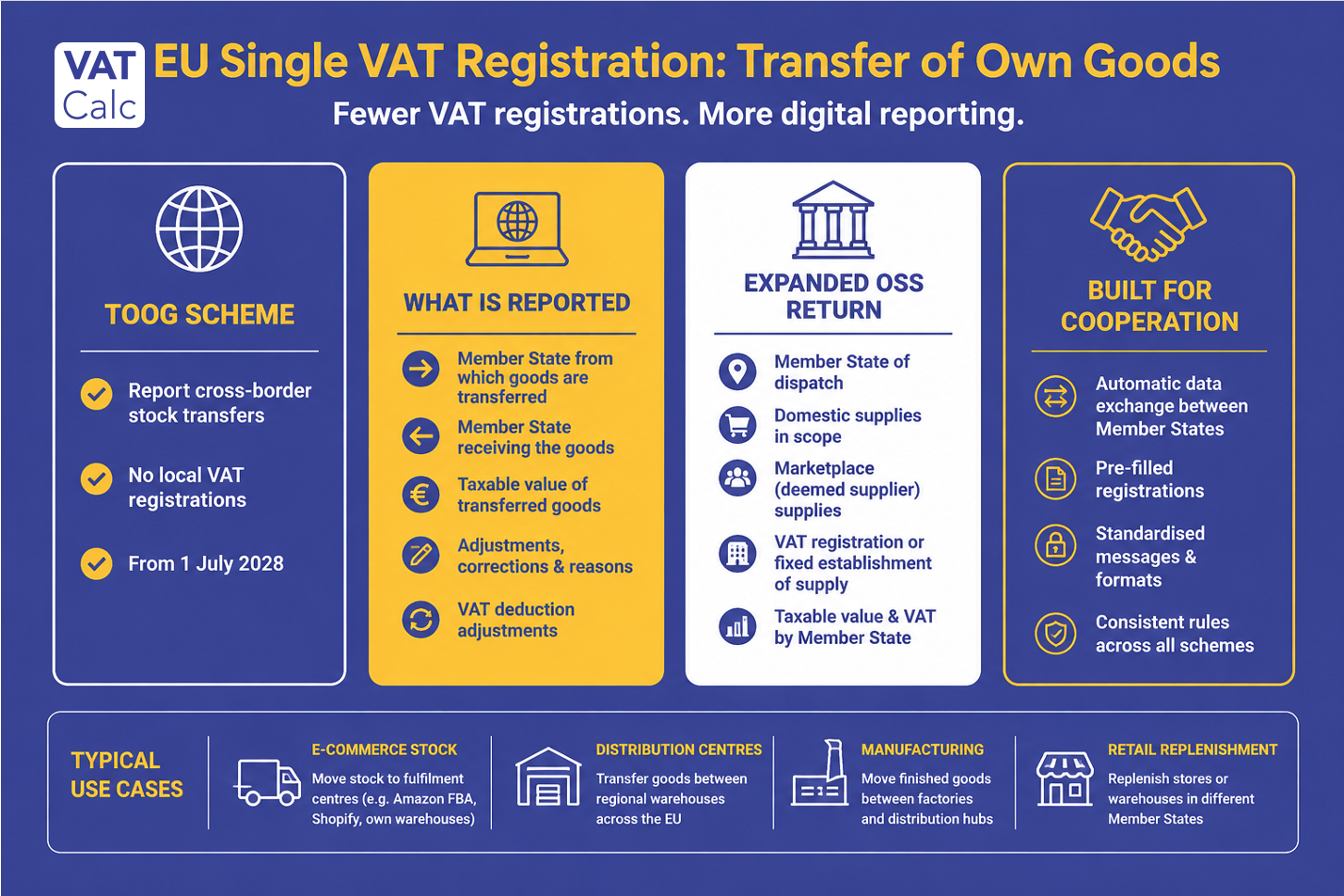
From 1 July 2028, many businesses moving inventory between EU Member States will no longer need multiple VAT registrations simply because they store or reposition stock across borders. Instead, qualifying transfers will be reported through a single expanded OSS VAT registration.
This will mean the withdrawal of call-off stock VAT simplification.
Who can use ViDA extended OSS?
The reforms are particularly relevant for businesses operating inventory across multiple EU countries, including:
- E-commerce fulfilment – Amazon FBA, Shopify fulfilment etc and marketplace sellers holding stock in multiple Member States.
- Regional distribution centres – businesses moving inventory between EU warehouses before customer sale.
- Manufacturers – transferring finished goods between factories, logistics hubs and distribution centres or call-off stocks at customers’ sites.
- Retailers – replenishing stores or local warehouses from central European distribution hubs.
For many of these businesses, stock movements are currently one of the biggest reasons for obtaining foreign VAT registrations.
From multiple registrations to single, monthly One Stop-Shop return
Today, moving stock from one Member State to another often creates:
- a deemed intra-Community supply;
- a deemed acquisition;
- a local VAT registration; and
- ongoing domestic VAT returns.
ViDA’s Transfer of Own Goods scheme aims to replace many of those registrations with reporting through a single VAT registration under the expanded One Stop Shop (OSS).
Also available for some B2C domestic transactions
The Commission’s implementation material makes clear that Union OSS will also cover certain B2C supplies of goods under Articles 36, 37 and 39, including supplies without transport and supplies where transport begins and ends in the same Member State. The new return structure expressly accommodates these transactions.
The trade-off: more detailed reporting required
The simplification comes with significantly more digital reporting.
Businesses using the Transfer of Own Goods scheme will report electronically:
- Member State from which goods are transferred;
- Member State receiving the goods;
- taxable value of transferred goods;
- subsequent adjustments;
- corrections to previous transfers;
- adjustments to VAT deductions on transferred capital goods; and
- reasons for adjustments.
OSS returns become much more detailed
The expanded Union OSS return will also capture considerably more transaction data. Businesses will report:
- Member State from which goods were dispatched;
- Member State of consumption;
- domestic supplies falling within the expanded Union OSS;
- supplies made through deemed supplier marketplaces;
- VAT registration or fixed establishment from which supplies originate; and
- taxable values and VAT rates by Member State.
The result is that tax authorities will be able to digitally follow inventory as it moves between Member States before ultimately being sold.
Determination and reporting become one process
This represents an important shift in VAT compliance.
Preparing the new OSS return will require businesses to capture not only the correct VAT treatment, but also the underlying commercial data that supports every stock movement.
VAT determination and VAT reporting can no longer operate as separate processes.
Every movement of goods will need to carry information such as:
- where the goods originated;
- where they moved;
- the applicable VAT treatment;
- the Member State in which VAT is due;
- subsequent corrections; and
- adjustment history.
How to manage TOOG? Single integrated determination and OSS reporting
Many organisations still use separate systems for VAT determination, ERP processing and VAT compliance.
Under ViDA, those disconnected processes become increasingly difficult to manage. Determination errors or incomplete inventory data will flow directly into the expanded OSS return, increasing reconciliation effort and audit risk.
That why at VATCalc we have developed the only solution that combines VAT determination (or tax engine) and VAT reporting within a single platform.
It combines legislative-coded VAT calculation with OSS return preparation from the same transaction data. As the Single VAT Registration replaces local VAT registrations with richer digital reporting, maintaining determination and compliance within one application will become increasingly important.
EU VAT in the Digital Age reforms
| EU VAT in the Digital Age | |
| 3 pillars to improve efficiency of VAT for all and reduce fraud | |
| 1. Digital Reporting Requirements; e-invoicing | Jul 2030-35: Mandatory digital reporting of intra-community transactions; obligation to be able to issue and receive intra-community e-invoices; member states free to impose own e-invoicing or real-time reporting but most conform to EU e-invoice standard EN 16931 |
| Read more about EU Digital Reporting Requirements (DRR) | |
| Structured e-invoices mandated for intra-community supplies | |
| EC Sales lists replaced by Digital Reporting Requirements | |
| 10-day e-invoicing deadline for intra-community sales | |
| 5-day e-reporting time limit intra-community purchases | |
| Withdrawal of EU permission requirements for e-invoicing | |
| Central VIES database launch | |
| 2 Platform economy | Jul 2028 / Jan 2030: Travel & accommodation sharing platforms to become deemed supplier / liable to users' VAT. New definitions of the roles of providers, users and platforms to avoid double and no-taxation (voluntary Jul 2028) |
| Read more - Travel & accommodation platforms deemed suppliers for EU VAT | |
| 3 Single VAT Registration; extension of OSS | July 2028: Following the 1 July 2021 introduction of the One Stop-Shop (OSS), extended to cover movement of own stocks prior to cross-border B2C to reduce the foreign, non-resident VAT registrations & returns. Plus to movements of own stock with ending of 'call-off' stock burden |
| January 2027 initial changes | |
| Transfer of own goods OSS extension | |
| Call-off stock VAT simplification ends | |
| Harmonisation of B2B Reverse Charge rules | |
| Creation of Single VAT Registration identiy | |
| Securing IOSS (Mar 2028) | |