Feb pilot launched for 1 Sept of e-invoicing and e-reporting mandate
The DGFiP (tax authorities) and AIFE (state’s financial information systems) on 24 February launched a pilot for the September 2026 B2B e-invoicing and B2C e-reporting. Work stars 27 February.
Businesses and their Plateformes Agréées (PA) agents can voluntarily join the trial to work with le Portail Public de Facturation (PPF) network when they are ready, and there is no predetermined end date before 1 September.

As of 24th February
- 139 Agreed Platforms Plateforme agréée ‘PA’ have a validated administrative file
- 106 platforms are definitively approved~25% operate via white-label models of which 61 are now joined the pilot
- 60,000 businesses are involved, out of 600,000 companies already listed in the directory.
24th February pilot launch
The pilot launch of 24th February 2026 is voluntary and the program started 27th, and it is deliberately broad to simulate live conditions:
- ✔️ Real transactional data
- ✔️ Full invoice transmission and lifecycle testing
- ✔️ Optional to include some or all taxpayers’ invoices
- ✔️ E-reporting option, too
- ✔️ “Right to make mistakes” for good-faith actors
- ❌ No use of pilot data by the tax authority
There is no pre-determined end date – it likely runs continuously until the authorities are satisfied it is stable ahead of September launch
Participation is driven by AP’s, public entities via Chorus Pro, and private companies using their chosen platforms. Crucially, this is a PROD-environment pilot, not a pre-production lab.
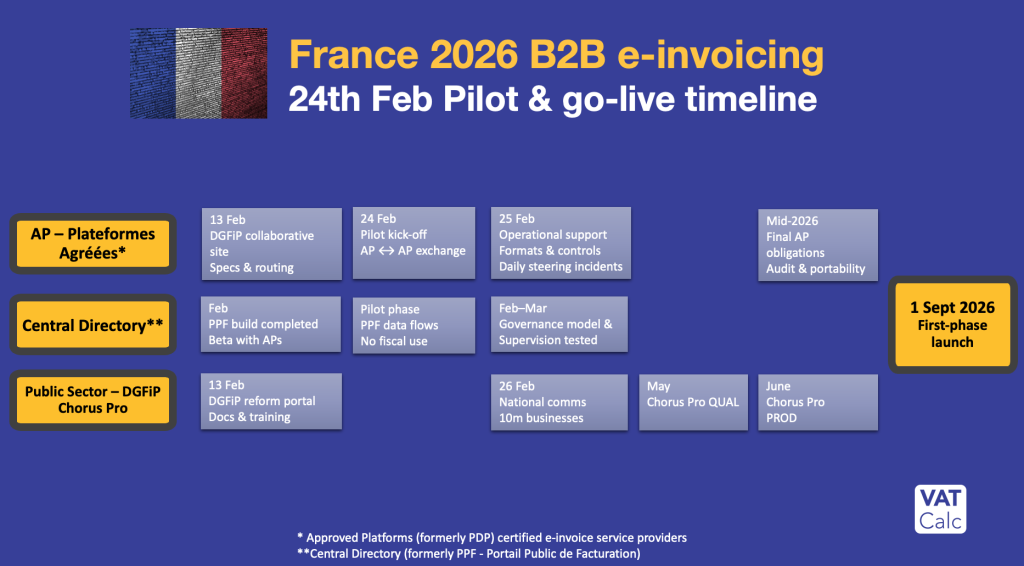
Key dates mapped to the AP / PPF architecture
13 February 2026 – Collaborative DGFiP site opens
Role: Ecosystem coordination:
- Shared workspace for AP’s, public bodies and regulators
- Central access point for schemas (Factur-X / UBL / CII), routing rules, rejection codes and clarifications
This is about convergence before volumes scale.
24 February 2026 – Pilot kick-off meeting
Role: Formal activation of live pilot flows:
- AP ↔ AP exchanges
- AP ↔ PPF data transmission where applicable
- Confirmation of test scenarios, governance and escalation paths
This is the first controlled “go-live” of the federated network.
25 February – Operational support phase
Role: Accompaniment and remediation:
- Resolving format, content and status issues
- Aligning interpretation of controls and lifecycle feedback
- Ensuring public-sector readiness
This phase is critical to preventing systemic failures later.
From 27 February – Daily B2B pilot steering committee
Role: Real-time supervision:
- Incident tracking
- Interoperability monitoring
- Data-quality and compliance oversight
This mirrors the future operational model once e-invoicing becomes mandatory.
What happens next: February to September 2026
Beyond the pilot itself, several structural milestones follow:
- 26 February 2026:
Launch of a national communication campaign targeting 10 million economic actors, positioning the reform as a simplification—especially for SMEs.
- May–June 2026:
New version of Chorus Pro opens supporting B2G and G2B invoicing.:
-
- May: QUAL environment
- June: PROD environment
- By mid-2026:
Finalisation of decrees and orders under Article 28 of the Finance Law, covering:
-
- Abolition of the public portal as a universal fallback
- Formal agreements
- Annual compliance audits for PDPs
- Portability obligations
- Strengthened (but tempered) sanctions
Enforcement in 2026–27 will prioritise good-faith compliance, consistent with France’s “right to make mistakes”.
Why this pilot matters as test of national scaling
The real challenge now is deployment. Out of 10 million economic players, only around 600,000 have actively chosen a platform so far. The pilot is therefore less about technology—and more about operational readiness, governance, and trust at scale.
By September 2026, France is aiming for a working country-wide one—and this pilot is the final proving ground.
Read more in our French VAT guide.