
BMF clarifies rules as Germany’s first major e-invoicing transition period ends on 31 December 2026
Structured invoice data, corrections, validation and penalties
Germany is approaching the next important phase of its mandatory B2B e-invoicing rollout, with the broad transitional concession for invoice issuance expiring at the end of 2026.

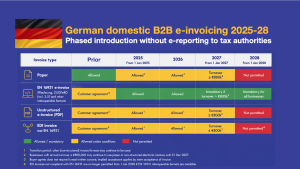
From 1 January 2027, German-established businesses with prior-year turnover above €800,000 will generally have to issue compliant structured electronic invoices for domestic B2B transactions.
Smaller businesses, with turnover of no more than €800,000 in the preceding year, may continue issuing other invoice formats until 31 December 2027. Certain existing EDI arrangements also benefit from the extended transition until the end of 2027.
All German businesses have already been required to be capable of receiving e-invoices since 1 January 2025.
Mandatory VAT data must be structured
The BMF says all VAT-mandatory invoice information must be contained in the structured data, rather than simply referenced in an attached contract, delivery note or other supporting document.
This includes the description of the supply. It must contain sufficient information to identify whether goods or services are being supplied, establish the VAT treatment and rate and, where relevant, determine the place of supply.
Supporting documents may provide additional detail, but cannot replace mandatory VAT data within the structured invoice itself.
This is also significant for Germany’s planned future transaction-based VAT reporting system. The structured invoice data is intended ultimately to provide the underlying reporting dataset.
Rebates and discounts
There is some simplification for rebate, bonus and cash discount arrangements where the eventual adjustment is not known when the invoice is issued.
A general reference to the relevant written agreement may be sufficient. However, taxpayers must be able to provide the underlying documentation promptly during a tax audit.
A subsequent amendment to a rebate agreement will also not, by itself, require the original invoice to be corrected.
Invoice corrections must also become electronic
The BMF has also clarified the treatment of invoice corrections. Where mandatory VAT invoice information needs correcting, the correction must generally also be made through an e-invoice.
For now, collective correction documents may continue to be used. But the BMF indicates these will cease to be acceptable once Germany introduces its planned transaction-level reporting system.
The traditional “red pencil” correction method, particularly common in the construction sector, will no longer be accepted.
Validation moves beyond checking the file format
Businesses should not treat e-invoice compliance simply as a technical test of whether an XML file conforms with an accepted syntax.
The BMF expects invoices to be reviewed for both:
- technical compliance, including correct implementation of the permitted syntax and automated processability; and
- VAT content compliance, including whether the mandatory information required under the German VAT Act is present and correct.
This potentially makes Accounts Payable validation more demanding. A technically valid invoice may still contain a VAT defect, while technical or semantic errors may prevent reliable automated processing even where the underlying VAT information is correct.
Penalty risk as 2025-26 transition ends
There is also an unresolved penalty issue.
Failure to issue an invoice, or issuing it late, can already constitute an administrative offence. The BMF has not definitively stated whether an electronically issued invoice that fails the required technical standard could trigger the same penalty provisions.
It has indicated that tax authorities recognise the implementation difficulties and that disproportionate enforcement should not be expected during the transitional phase.
But the important question is when that tolerance ends.
For many larger businesses, the first significant transition expires on 31 December 2026.


