
Netherlands July 2030 domestic B2B e-invoicing; July 2031 e-reporting mandate
11 September 2026: The Dutch Secretary for Finance confirms to House of Representatives more details for the proposed domestic electronic invoicing 1 July 2030 and then e-reporting from 1 July 2031. This coincides with July 2030 EU ViDA plans for mandatory e-invoicing and e-reporting for EU B2B sales of goods and services.
This is an update from March 2026. Many questions remain (see below), including final technical architecture role of Peppol and accredited service providers.

Legislative process by mid2028 to be followed by testing and 2030-31 launch
Estimated timetable
- 10 March 2026: Mandate design presented to Parliament
- 11 September: Ministry of Finance updates proposed model and 2030-31 timetable.
- 2027: Consultations and legislative formulation period before approval by Cabinet and submission to House of Representatives by mid-year
- Mid-2028: Legislation completion, allowing a promised two-year implementation window covering recognition of structured e-invoicing EN 16931;
- 2028-29: build and pilot phases, Peppol exchange, accreditation regime for service providers
- July 2030: Go-live for domestic B2B e-invoicing exchange
- July 2030: ViDA intra-community B2B e-invoicing, and ViDA e-reporting
- Jan 2031: e-reporting of domestic transactions
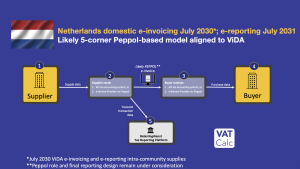
Proposed technical operating model
- Structured e-invoices aligned to EN 16931 (UBL/CII formats) only as semantic standard but no details on syntax or transport;
- 5-corner Peppol-style exchange model for transmission; but to be confirmed
- A reporting layer (“5-corner”) enabling near-real-time data submission to the tax authority for intra-community ViDA obligations and interoperability
- Data Protection limits to require only minimal transactional data e-reporting, and its access and use by tax authority staff to be limited by their need and roles
Netherlands aligns domestic mandate with ViDA
The government says extending e-invoicing and digital reporting to domestic transactions is necessary to improve VAT fraud detection, strengthen tax authority controls and support the wider digitalisation of the economy.
For domestic transactions, the Netherlands intends to use the EU EN16931 structured e-invoicing standard. The government has said it does not currently intend to recognise additional national invoice standards alongside it.
Invoices Must have to be issued within 10 days of the supply, which synchronises with the ViDA intra-community 10-day requirements.
Peppol likely, but not yet confirmed
The final invoice exchange infrastructure has not yet been selected.
However, Peppol currently appears the most likely model.
An EY study commissioned by the government recommended that the Netherlands mandate use of the Peppol network for B2B invoice exchange. Peppol is already used in the Netherlands, particularly for invoicing public authorities.
Exemptions to the new Dutch digital reporting requirements
- Special regimes, including TOMS, public transport, resellers etc
- Simplified invoices
- VAT Exempt suppliers
- Small business regime
More questions to answer in 2028 legislation writing
Further work is continuing on:
- interoperability;
- the relationship between e-invoicing and digital reporting;
- exact limits of domestic e-reporting requirements;
- secure and reliable data exchange;
- role and competition between accredited service providers; and
- tax authority supervision and enforcement – including penalties.
The government also wants to take account of developments around the proposed European Business Wallet before making a final infrastructure decision.
Domestic e-reporting from July 2031
From 1 July 2031, businesses will be required to report selected data from domestic B2B electronic invoices to the Belastingdienst.
The intention is not necessarily to transmit every field from the invoice. The government plans to apply the same data-minimisation principles being developed at EU level, with only a defined subset of invoice information reported.
This reflects Dutch concerns around privacy, commercially sensitive information and data security.


