Spain hybrid public-private e-invoicing model, mandatory central repository and phased October 2027–2029 reporting obligations
On 5 October 2026, the Ministerial Order approving the Crea y Crece mandate for B2B e-invoicing with e-reporting was approved along with technical rules – 4 syntaxes: UBL, CII, EDIFACT and Facturae, based on the EN 16931 semantic model. The first wave 6 October 2027 launch for businesses with turnover above €8 million is therefore confirmed.
31 July: Senators call for consolidation of e-invoicing with existing SII real-time reporting and VERI-FACTU certified software obligations

The technical and functional specifications Order HAC/1028/2026 sets the following implementation dates:
- 6 Oct 2027: businesses and professionals with annual turnover above €8 million
- 6 Oct 2028: all other businesses and professionals within scope
- 6 Oct 2029: Invoice-status and payment reporting obligations for individuals and entities under income-attribution regimes with turnover not exceeding €8 million
Spain completes B2B e-invoicing hybrid framework
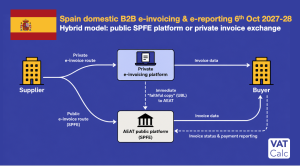
Spain will operate a hybrid model. Businesses may use the Spanish Tax Agency’s free Public Electronic Invoicing Solution, SPFE, qualifying private e-invoicing platforms, or a combination of both.
Private platforms may exchange invoices directly with each other or use the SPFE for interconnection.
However, the AEAT now makes clear that the SPFE will operate as the universal and mandatory repository for Spanish B2B electronic invoices. Where an invoice is issued through a private platform, a faithful electronic copy must be transmitted simultaneously to the SPFE.
The faithful copy is not necessarily a complete conversion of the original invoice. It contains the required tax information with equivalent semantics, is specifically identified as a copy and must be transmitted in UBL format.
Direct electronic transmission between supplier and customer without using either a qualifying private platform or the SPFE will not satisfy the new regime.
EN 16931 semantic and choice of syntaxes
Spain’s B2B e-invoicing model is based on the European EN 16931 semantic standard.
The permitted invoice syntaxes include UBL, UN/CEFACT CII, EDIFACT and Spain’s Facturae format. Private e-invoicing platforms will be required to support interoperability between the permitted formats.
Where invoices are exchanged through private platforms, the faithful copy transmitted to the AEAT public solution will use UBL.
Invoice and payment statuses e-reporting
The system will support reporting of invoice statuses including rejection, payment, collection and non-payment. The technical framework also provides for unique invoice identification, automated invoice retrieval and machine-to-machine communication between platforms and the AEAT public solution.
These requirements will give the tax authority greater visibility over the lifecycle of B2B invoices and their payment.
The AEAT public platform must be available at least two months before the first October 2027 mandate. The technical rules also specify a unique invoice identifier combining the supplier’s NIF, invoice number, series and issue date. They establish validation, rejection and correction procedures, including arrangements for technical failures. Faithful UBL copies submitted to the public platform cannot include attachments.
Transitional PDF requirement in first wave
Businesses above the €8 million threshold must, during their first 12 months within the mandate, accompany electronic invoices with a human-readable PDF when invoicing other businesses and professionals.
The PDF is a transitional accompaniment to the structured electronic invoice, rather than an alternative to it.
Crea y Crece and VERI*FACTU remain separate obligations
Spain’s B2B e-invoicing mandate should not be confused with VERI*FACTU
The Crea y Crece regime governs electronic invoicing between businesses, while VERI*FACTU forms part of Spain’s separate anti-fraud requirements for invoicing software.
Businesses and software providers may therefore have to accommodate both regimes within their invoicing processes.
Businesses can now move to implementation
The publication of Order HAC/1028/2026 removes a key remaining uncertainty around Spain’s B2B e-invoicing rollout.
ERP, accounting and e-invoicing providers can also move ahead with development against the final technical requirements, including EN 16931 interoperability, AEAT reporting and invoice-status management.
E-invoicing to fight VAT Gap
The proposal to extend mandatory e-invoices to all businesses and non-incorporated businesses for business-to-business transactions aims to improve the efficiency of business operations but also to help fight VAT fraud. The European Commission’s VAT Gap estimates that Spain lost €6.8 billion in expected Value Added Tax revenues.
EU VAT in the Digital Age reforms include a channel for harmonised Digital Reporting Requirements (DRR) and Continuous Transaction Controls (CTC) by EU states. This will impose mandatory e-invoicing for EU intra-community transactions from 2030.
Italy’s SdI e-invoice regime has shown remarkable success in closing its VAT Gap by almost 10% in just one year. France and Poland are to follow with 2026 being a big year for European e-invoice initiatives. The EU e-invoice consultation is well underway.
VAT Calc’s in real-time global Calculator and Auditor services produce instant and accurate tax calculations into your e-invoice, ERP, billing or e-commerce systems.