Ministry of Finance v1.1 e-Invoicing guidelines issued ahead of July 2026 pilot
- Taxpayers remain legally responsible for invoice storage, even when using an ASP.
- Advance payment and retention invoice rules have now been clarified within the Peppol framework.
- VAT groups receive a 24-month transition period, but must still prepare for future compliance.

Peppol PINT AE-based e-invoicing in 2027
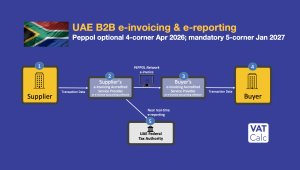
The launch timetable remains:
- Apr 2026: 4-corner model for e-invoicing only launched
- July 2026: voluntary pilot phase
- Oct 2026: first wave tax payers must appoint Accredited Service Provider
- Jan 2027: first wave taxpayers above AED 50m turnover
- Jul 2027: second wave taxpayers below AED 50m turnover
- Oct 2027: B2G
- Jan 2029: Intra-group
Ministry of Finance clarifies e-Invoicing rules ahead of July pilot
The guidelines reaffirm that e-invoicing will apply to all businesses operating in the UAE, regardless of VAT registration status, unless specifically excluded under Ministerial Decision No. 243 of 2025.
Storage responsibility stays with taxpayers
One of the most significant additions is a new appendix covering invoice storage requirements.
The Ministry confirms that businesses remain legally responsible for invoice archiving even where an Accredited Service Provider (ASP) performs the storage function on their behalf.
Importantly, the UAE has adopted a practical interpretation of the requirement to store data “within the State”. Invoice data may be hosted on overseas cloud infrastructure provided integrity, security and prompt access for the Federal Tax Authority (FTA) can be guaranteed throughout the retention period.
This clarification will be welcomed by multinational businesses using global cloud platforms.
New guidance on advance payments and retentions
The second new appendix addresses two common invoicing scenarios.
For advance payments, businesses must issue an invoice when payment is received, with the final invoice covering only the remaining balance. The guidelines also explain how advance and final invoices should be linked within the Peppol PINT-AE framework.
For retention amounts commonly used in construction and project-based industries, businesses may continue existing accounting approaches, including issuing separate invoices when retained amounts become payable.
VAT groups receive temporary relief
The Ministry has also confirmed a 24-month transitional period for transactions between members of the same VAT group, beginning on 1 January 2027.
However, this is a deferral rather than a permanent exclusion. VAT groups will ultimately need to comply with e-invoicing requirements and should begin preparations now.
For regular free updates register for our global VAT and GST news.